Sunday, February 20, 2022

Harlequin Ducks at Port Aransas Jetty, 2/20/22

Trip Davenport from up near Uvalde has been on a roll.  A couple of weeks ago he positioned himself at the end of the Port Aransas Jetty on a cold windy day and was rewarded with an "in yo face" view of a Parasitic Jaeger.  That's a species I've never seen in Texas so I went up the next day and spent a few hours at the tip of the jetty to no avail.  Then a week later, Trip runs up to Lake Tawakoni for Smith's Longspurs and has another close encounter with a hard to find Texas species.

Well yesterday he was back at the Port Aransas Jetty and damned if he didn't find a couple of female Harlequin Ducks.  There are only two previously accepted records of this species for Texas, the last in 1995.  I've seen them numerous times in the Pacific Northwest but never in Texas.  Problem is after some crippling views, the two ducks shot across the channel to the opposite jetty and disappeard from view not to be seen again.  But I figured the jetty habitat would be perfect for them so maybe they would return.  

So I got up at early and made the three hour drive.  As I got within a half hour from the site, I read on Facebook that the two Harlquin Ducks had be refound along the south jetty.  This turned out to be one of those special times when after a long drive, the rarity was waiting and served up on a silver platter.


The two ducks looked quite at home searching for algae and crustaceans in the roiling surf, much like when I've seen them along the rocky coast of Oregon.


Ten or so birders got to enjoy the rare visitors.  Unfortunately, a noisy boat got too close and the Harlequin Ducks flushed and shot across the channel towards the north jetty and then headed far to the east.  One birder followed them in his scope till he lost them near the Intercoastal Waterway.  They were not seen again today.  I'm glad I made the early start.


Saturday, December 18, 2021

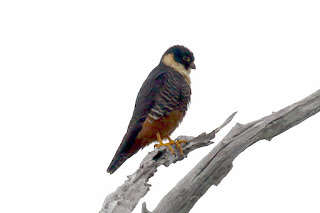
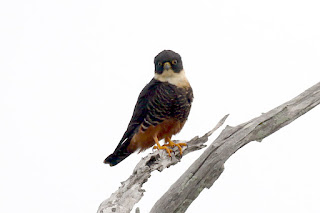
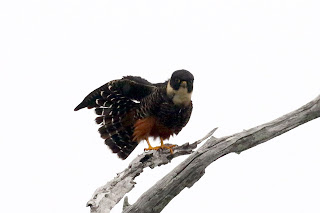
First US Record of Bat Falcon at Santa Ana NWR, 12/18/21

About a week ago, a visiting birder posted on Facebook a poor image she had taken at Santa Ana NWR a couple of days earlier (12/8/21) of what appeared to be a Bat Falcon.  This would be the first record for the United States of this neotropical species that occurs from central Tamaulipas to northern Argentina.  It has long been expected.  Birders spent the following day not finding anything while I stayed home and tended to other things.  Plus the trail was cold and I didn't feel like putting in the effort.

Over the past week I've been doing a lot of yard work and chasing butterflies and goldeneyes (see below) and there's been no further sightings of the Bat Falcon.......untill this morning.  Troy and Marla Hibbets from Bracketville are often in the Valley looking for dragonflies but they have recently become hard core birders.  And today they came down to take a stab at the Bat Balcon and darned if they didn't find it while scoping from the hawk tower.  I got over there a bit later and joined the group on the crowded tower where I got some poor scope views of the distant first US record.  Well that was good but not great.  The Bat Falcon was perched on very distant dead snags somewhere in the direction of Cattail Lakes.  So I decided I had nothing to do but take a walk in that direction and soon came a report that the bird was being seen close up on the tour road near Cattail Lakes.  I got over there and there was Troy and Marla and several others and a Bat Falcon.

I've seen lots of Bat Falcons in Mexico so it wsn't a lifer but it was new for my ABA list which is around 685 and more importatly it was Hidalgo County species # 411.


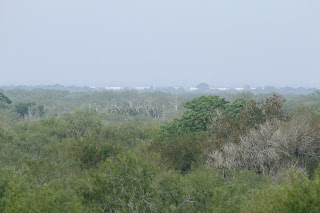
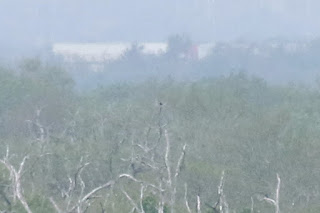
Here's a shot from my original viewpoint on the tower.  By Google Earth I estimated the distance to be .97 miles.  The Bat Falcon is the black speck in the center.  I finished the morning walking nearly four miles in total.


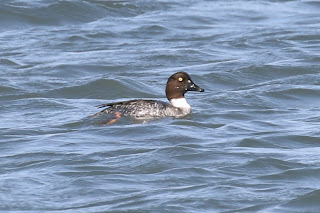
A couple of days ago a Common Goldenye was found at South Padre Island during the Christmas Bird Count.  I ran over the next day and was happy to find this deep water duck that rarely makes it this far south.  It was my 421st species for Cameron County.


That's a pretty good pair of birds!